
THE GREAT ARTIFICIAL INTELLIGENCE TRADE | Part 2: Laborpocalypse
Here's how to profit from unemployment

Doug put out a piece on the “Engle’s Pause” phenomenon about to hit all of white-collar labor. It is excellent and it is free. Thanks, Doug.

Let’s turn it into a trade.
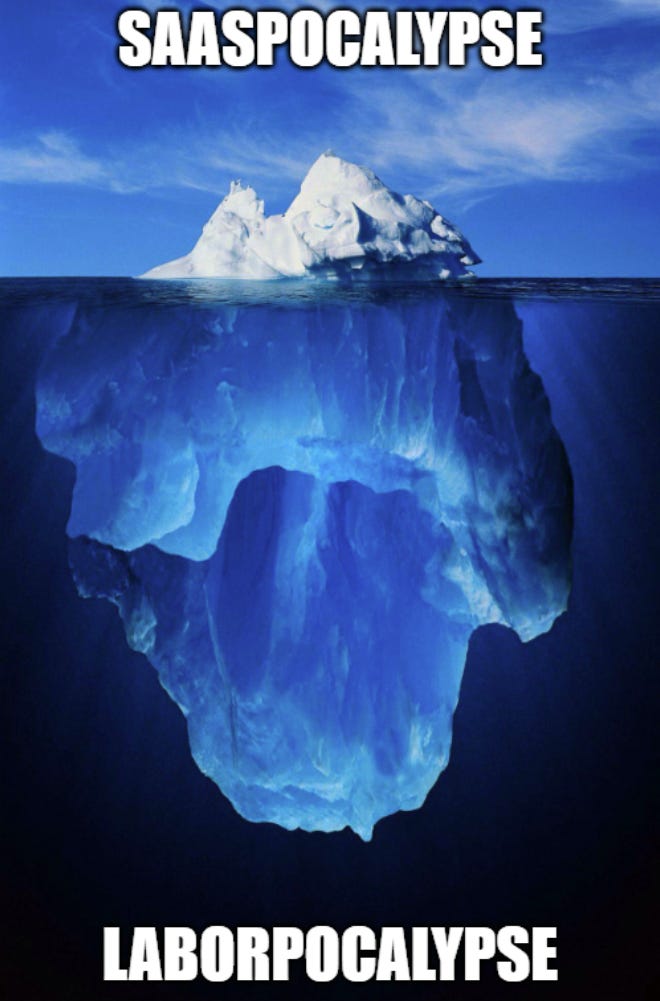
Memory chips might be in a shortage, but what is certainly not is the mentions of the term “SaaSpocalypse”. SaaS names are hated and some are down 60% on the year. However, the same doesn’t seem to be true for a class of companies I believe are far worse positioned (and make for a cleaner short). I think we will be front-running a new FinTwit/FinX hivemind phenomenon I’ll call
Laborpocalypse.
By accessing this content, you acknowledge and agree to our terms and conditions. This research is not financial advice.
Contents
What Makes a Good Short
The Handweaver Analogy
Why Labor Pass-Through Is the Best Short
Why the Friction Economy and SaaS Are Popular But Inferior Shorts
Staffing vs Outsourcing
The Short Basket
What Makes a Good Short
Most retail investors think about shorts the same way they think about longs in reverse: find a company that’s overvalued, bet against it. Or the classic “a long position has a capped downside (you lose 100%) and unbounded upside (a stock can go up 10x) while a short position is the opposite: capped upside (the stock goes to zero, you make 100%) and theoretically unbounded downside (a stock can squeeze 5x against you).”
I think a better interpretation is this.
A short is path dependent. That means you can have a totally correct thesis but blow up if the name rallies in your face before the eventual drop (and maybe it becomes a meme stock and stays elevated forever!). A long is path independent. If Buffett owns an undervalued company, he gets paid eventually, whether it’s through buybacks, dividends or share price appreciation.
This means shorts aren’t about expected value the way longs are. They’re about certainty and narrowness of outcome distribution. A short with a 70% chance of working and 30% chance of squeezing violently is a worse trade than a short with a 60% chance of working and 40% chance of slowly grinding sideways. The path matters as much as the destination.
The implication: the best shorts have three properties. First, the disrupting mechanism has to be already operating, not theoretical. You don’t want to bet that AI will eventually disrupt some industry; you want the disruption to be visible in current data. Second, the company’s defensive options have to be limited. Businesses with multiple paths to survival (acquisition, pivot, internal restructuring, reinvention) make for bad shorts even if one of those paths is unlikely to succeed. Third, the customer behavior required for the thesis to play out has to be passive, not active. Shorts that require customers to actively make hard decisions (replace systems, fire employees, migrate platforms) take years to play out and frequently get derailed. Shorts that require customers to simply not do something, like not renew, not hire, not extend, work fast.
Hold these three criteria in mind. They’re what we’re going to use to identify the cleanest AI disruption short available right now.
The Handweaver Analogy
Doug’s Engels’ Pause piece does something important: it correctly identifies the modern handweaver as the human white-collar worker, not the businesses around the worker. This sounds obvious once stated but matters enormously for trade construction, because most investors are looking at the wrong target.
In 1780, the obvious “AI disruption short basket” would have been: handloom manufacturers (the tools), wool brokers (the input suppliers), thread merchants (the consumables), and weaving factories (the businesses employing weavers). All of these were affected. But the primary disruption, the largest, fastest, most certain wealth destruction, happened to the weavers themselves. Skilled middle-class artisans saw their wages collapse 50% in a generation. The businesses around them got reorganized; the weavers got destroyed.
Translate to today. The information artisan is the analyst, the marketer, the support rep, the junior associate, the tax preparer, the underwriter, the developer. Roughly 70 million workers in the US, about 44% of the workforce, accounting for 40-45% of GDP. This is the modern handweaver class, and AI is the modern automated loom.
Now map the businesses around this worker class:
The tools the modern weaver uses, like Excel, Word, Photoshop, Figma, are productivity software. These are direct analogs to the physical handloom. They’re physical (or digital) infrastructure that augments human labor.
The businesses that productized weaver workflows and sold them back as services are SaaS, like Salesforce, ServiceNow, Workday, Monday.com, HubSpot. These are the modern equivalent of weaving factories: businesses that organized weavers, gave them better tools, standardized their output, and sold the results to enterprises.
The agencies that placed weavers in factories are staffing and outsourcing firms. Their entire product is the weaver. They don’t make tools; they don’t run factories; they place weavers and bill for the placement.
This is the part most investors miss. When you’re trying to short AI disruption, you’re really asking: which of these three layers loses first, fastest, and most certainly? The instinct of finance Twitter is to short the tools (software). The Engels’ Pause analogy says you should short the agencies (labor pass-through).
Below the paywall we discuss why labor pass through is the best short, contrast it with the other popular AI shorts (friction economy and SaaS), explain the main business models in labor, and end with a specific short basket.